I grew up knowing one thing with the kind of certainty children usually reserve for gravity.
I was never my father’s favorite.
That title belonged to my older sister, Victoria.
Victoria was everything people liked in a daughter. Beautiful, bright in a performative way, graceful when people were watching, quick to laugh, and quicker to charm.
She walked into a room, and people noticed. I walked into a room, and people adjusted around me like I was furniture.
My father never said it out loud, of course. Men like him never do. They prefer to let favoritism show through smaller things, the things nobody can accuse them of if they are careful.
Victoria got the better schools, horses, and jewelry on her birthdays. When she spoke, he listened. When I spoke, he glanced at his watch.
After my mother died, that difference became glaring. I was 15.
Victoria was 18 and being treated like a crown jewel to be displayed at charity dinners.
My father buried his grief under work and discipline and the kind of cold authority that makes a house feel like a hotel.
He did not become cruel. He became uninterested. And indifference, I learned, can bruise deeper than anger.
I read a lot in those years because books were easier than people, and because if nobody expected much from you, you had a great deal of freedom to notice things.
I read financial papers at breakfast because my father left them behind. I read business journals in the library while Victoria went to parties. I learned the names of men who moved industries with a signature and women who built fortunes while their husbands took the credit.
That is how I knew the name Alexander long before anyone ever placed his photograph on our dining table.
But I am getting ahead of myself.
The day my father announced our marriage, he did it the way he did everything important: without warmth and without asking.
Victoria and I were seated across from him in the formal dining room, the one nobody used unless there was bad news or an ambassador involved. He placed two photographs on the polished table between us, both face down.
“Both of you are old enough,” he said. “I’ve reached agreements with two families. You will each marry one of the men represented here. Choose.”
Victoria actually laughed. “You’re serious?”
“Completely.”
She looked offended for maybe half a second, then intrigued.
That was Victoria. Outrage never lasted if a better opportunity stood nearby.
I said nothing.
Our father folded his hands. “Victoria chooses first.”
Of course she did.
She reached out immediately and snatched the photograph on the left. I took the one that remained.
“Turn them over,” our father said.
We did, and the room changed.
Victoria’s face drained of color first. Then my father’s.
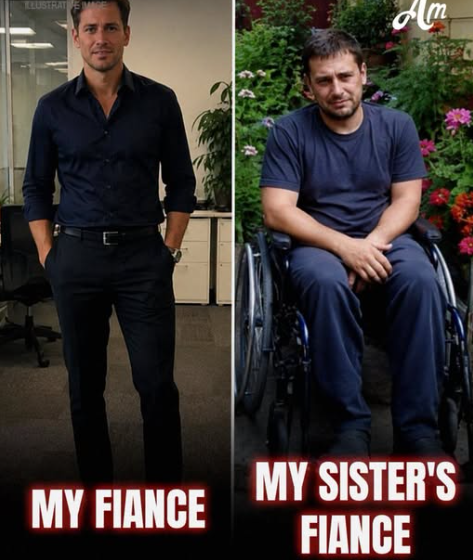
I looked down at my photograph and found Daniel looking back at me. Young, elegant, expensive-looking in a way that suggested inherited money and excellent tailoring.
Heir to the Ashford Group. He was constantly in magazines, widely praised, much photographed, and, if gossip columns were to be believed, intolerably pleased with himself.
Then I looked at Victoria’s.
Alexander.
He wore a dark suit and a calm expression. One hand resting on the wheel of a chair he had been using since his tragic accident.
After the accident, he had almost disappeared from public life. Rumors said partial paralysis and months in rehab. Rumors said he had become bitter, strange, and reclusive.
What the rumors never mentioned was that Alexander’s personal fortune dwarfed Daniel’s entire family name.
I knew that, and so did my father.
Which was why the terror on his face interested me far more than Victoria’s outrage.
“I’m not marrying him,” Victoria said.