
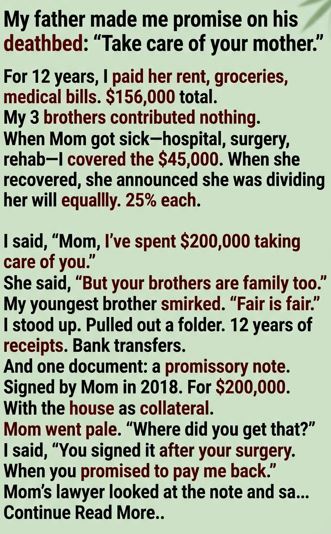
I promised I would.
And for the next twelve years, I kept that promise.
When Mom struggled to pay rent, I paid it.
When she needed groceries, I bought them.
When medical bills arrived, I covered those too.
Little by little, the total reached $156,000.
My three brothers contributed nothing.
Not a dollar.
Not a weekend.
Not even a phone call most months.
Still, I never complained.
She was my mother.
Then everything changed.
At seventy-two, Mom became seriously ill.
Hospital stays. Surgery. Rehabilitation.
The bills totaled another $45,000.
I paid every cent.
Thankfully, she recovered.
A few months later, she called a family meeting.
Everyone gathered around her dining room table.
Then she announced she was dividing her estate equally among her four children.
Twenty-five percent each.
I stared at her.
“Mom, I’ve spent nearly $200,000 taking care of you.”
She nodded.
“I know.”
“Then surely that should be considered before the inheritance is divided.”
Before she could answer, my youngest brother smirked.
“Fair is fair.”
The others agreed.
I felt like I’d been punched in the stomach.
For twelve years, they had done nothing.
Now they wanted equal rewards.
I stood up and walked to my car.
When I returned, I carried a thick folder.
Inside were twelve years of receipts.
Bank transfers.
Canceled checks.
Medical invoices.
Proof of everything.
My brothers rolled their eyes.
Then I removed one final document.
A promissory note.
Signed by Mom in 2018.
Amount owed: $200,000.
Collateral: the house.
The room went silent.
Mom’s face turned white.
“Where did you get that?” she whispered.
I looked at her.
“You signed it after your surgery. You told me you didn’t know how long recovery would take. You promised to pay me back someday.”
My brothers laughed nervously.
They assumed it wasn’t valid.
Mom’s attorney, who had been sitting quietly in the corner, asked to see it.
He adjusted his glasses and read every page carefully.
Then he looked up.
“This appears to be legally enforceable.”
Nobody spoke.
The lawyer continued.
“If this debt is valid, it must be satisfied before any inheritance is distributed.”
My youngest brother’s smile disappeared.
“Wait… you mean he gets the money first?”
The lawyer nodded.
“Creditors are paid before beneficiaries.”
For the first time, my brothers realized the situation had changed.
Completely.
A week later, the attorney completed his review.
The signature was authentic.
Witnesses had signed.
The document had been properly notarized.
There was no loophole.
No argument.
No escape.
The debt was real.
Mom later called me privately.
Tears filled her eyes.
“I never thought you’d actually use it.”
I took a deep breath.
“I never thought I’d need to.”
Then I told her something she didn’t expect.
“I don’t want your house, Mom. I don’t want to fight. But I also won’t pretend the last twelve years never happened.”
For a long moment, she sat quietly.
Then she nodded.
“You’re right.”
A revised estate plan was created.
The debt was acknowledged.
The remaining assets would be divided afterward.
Not equally.
Fairly.
And for the first time in years, nobody argued.
Because the receipts told the story no one else wanted to hear.
❤️ Lesson: Helping family should come from love, but love doesn’t require erasing sacrifice. Fairness isn’t always equal—it’s recognizing the contributions that made everything else possible. 👇💬